A Knight in shining armor is a man whose metal has never been tested.
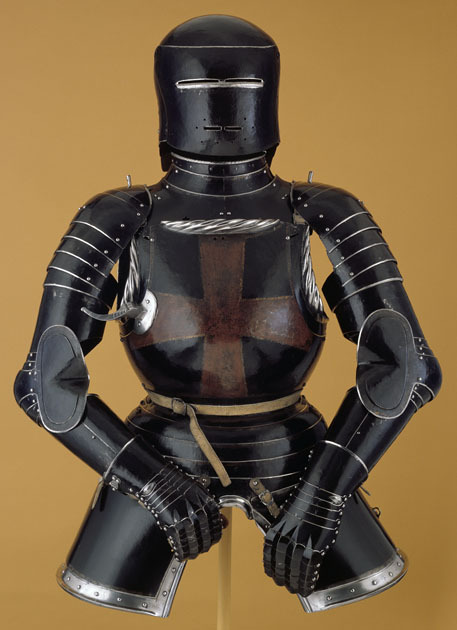
Or one who regularly cleans it…but yeah, “Black Knights” were called so because their armor was in terrible condition, and they were usually much more experienced, so they usually won tournaments.
I’m curious mainly where you got this concept from…
“Black Knights” need to be distinguished by context. I’m on my phone right now so I can’t link you all the sources I’d like to use, so please pardon me for that.
So, the concept of “knight in shining armour” comes from the idea of the knight-errant in medieval fiction, the sort of person who is on a quest, is all shiny and new, ready to test themselves. It also is a nod to the maintenance of equipment, or the wealth of a Knight; in the late medieval and Renaissance periods, well-off knights might have a suit of armour for warfare, a suit for tournaments, and a suit for formal occasions. These being used for different things, they were meant to be maintained well and show status and wealth.
So, where does the concept of a black Knight actually come from?
Surprisingly, most cases come from the idea of the tournament. Knights were meant to display who they were, “show their colours” (ie, heraldry), and show off their skills in combat. But if course you had some knights who didn’t want to show who they were, who they were fighting for, or which lady they favoured, etc. This sounds like a chivalric fantasy, and honestly, that’s what tournaments really became as time went by and the events became more formal.
Now, early “black Knights” , were those who did not wear dark or black armour, but in fact those who did not use their own heraldry, disguising themselves. Again, they may do this for various reasons, but the concept is they hide their identity. Occasionally, they might actually paint their shields black.
We also have the examples from the hundred years war where French and English knights painted their armour different colours: black for the French, Red for the English.
Some knights actually WOULD favour black armour or heraldry to the point they got called “black Knights”, and not as a derogative. The Polish Knight, Zawisza Czarny (pronounced “Zah-vu-shah Shar-ny”, approximately) become known for his feats of arms, and by his dark armour.
Linking back to the original quote, a Knight in shining armour could well be a black knight, as such. But more commonly, it meant he was either wealthy, or highly skilled at arms.
Or both. 😛
I’ve seen enough period art to convince me that “shining armour” was often a lot darker than the chrome-plated image which the term suggests.
I’ve also long thought that the whole business of “knights in shining armour” wasn’t a medieval concept at all, certainly not the default one, but was a Regency / early Victorian fictional conceit from Romance poets and Sir Walter Scott’s historical fiction. (About 10 years ago an actual expert said more or less the same thing, leaving actual amateur me feeling rather smug…) :->
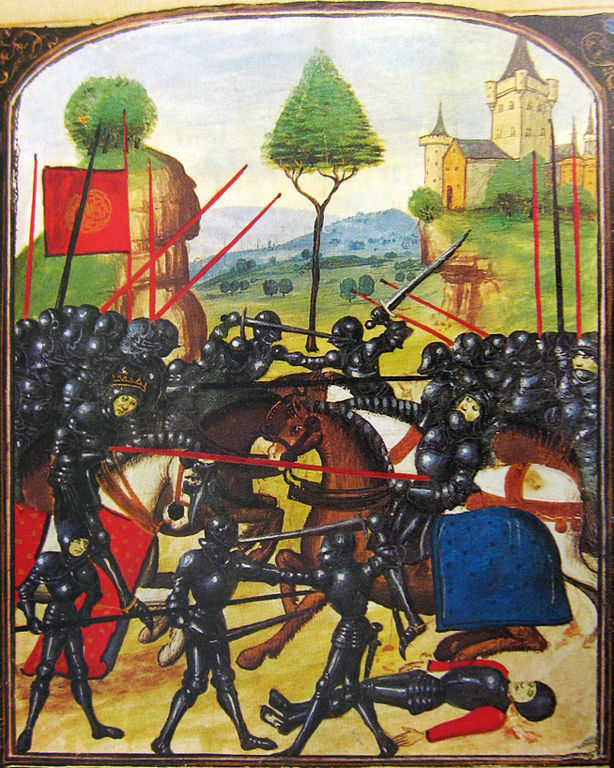
This illumination features armour that’s black or dark blue in colour, but with
the carefully-delineated highlights
of a shiny surface. There are many other like it.
Armour was coloured for both decorative and practical purposes; chemical blueing with acid produces a very dark, lustrous and effectively rust-resistant finish like the one in the medieval illustration. I once had an Arms & Armor rapier with that finish on the hilt: it looked like this…
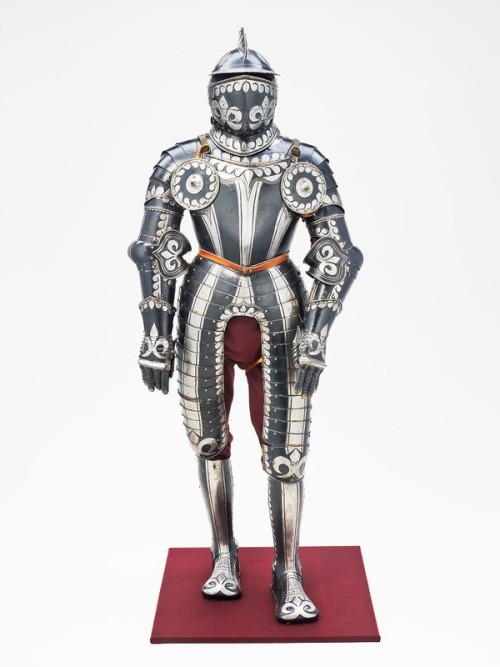
Heat-blueing, which was more blue than black, was a popular treatment for Greenwich armour of the Elizabethan period, as was browning and russetting (all of which were and are used on firearms), processes which used heat, chemicals or controlled “good rust” to create colour and also prevent uncontrolled “bad rust”.
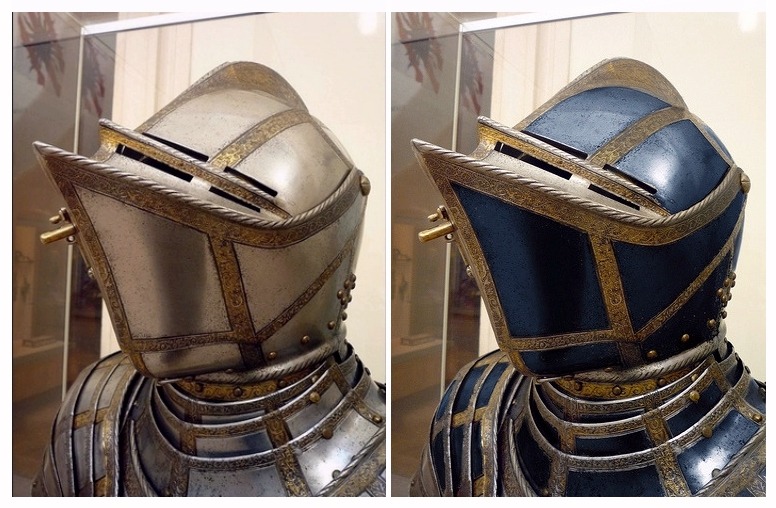
Here’s the helmet of Sir James Scudamore’s Greenwich harness, which was once blued and gilt.
The image on the left is how it looks now, after being thoroughly scrubbed with wire wool, sand or other abrasives at some stage in the 19th century to make it “shining armour”. The image on the right is a CGI restoration of its original appearance, based on still-visible traces of colour in the grooves beside the gold strapwork.
Here’s the browned and gilt “garniture” (armour with extra bits for different styles of combat, like a life-size action figure) of George Clifford, Earl of Cumberland. I don’t think grinding this beauty down to bright metal would be an improvement…
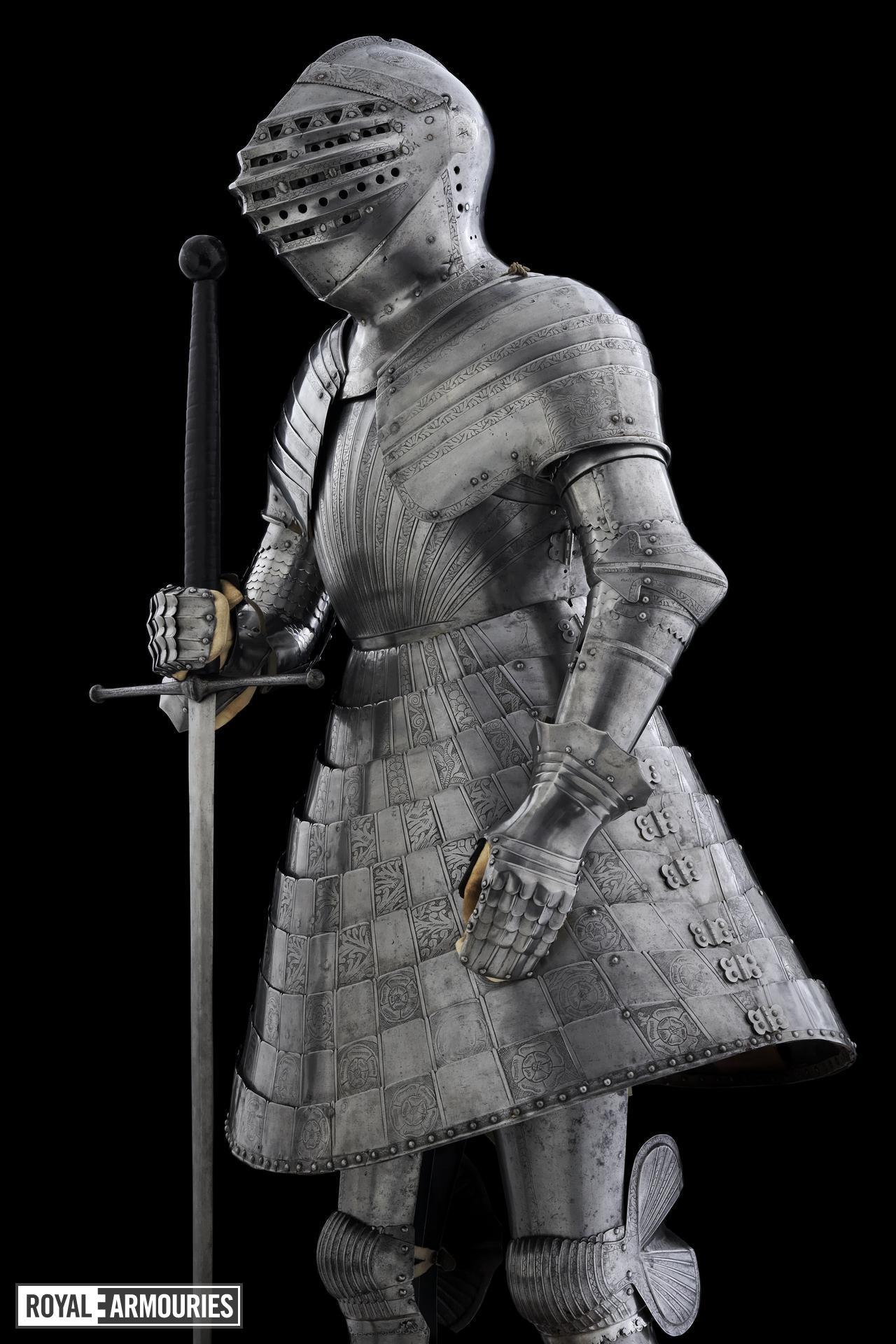
Henry VIII’s tonlet (skirted) armour for foot combat at the Field of the Cloth of Gold now looks like this:
Originally it would have been shiny black or dark blue with gilt details and the engraved panels picked out in coloured paint or enamelling – red Tudor Roses, green leaves etc., but that wasn’t “shining armour”, so…
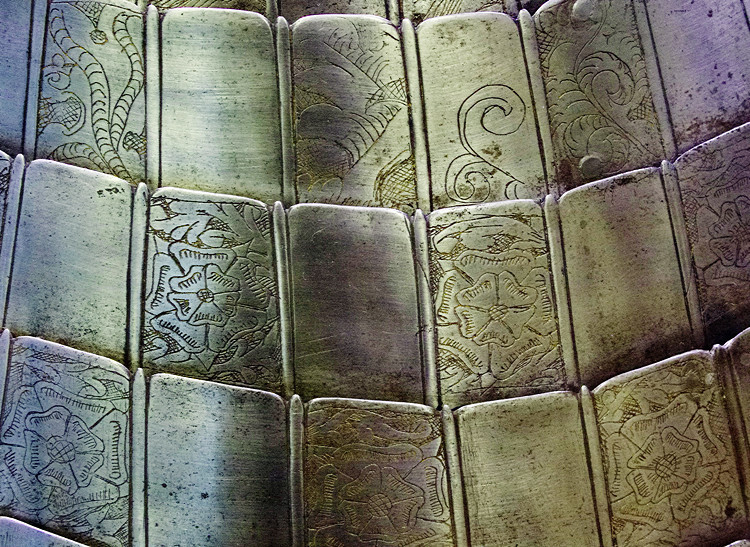
This detail shot shows the fine score-marks left after it was sanded “clean”, with dark pigmentation in the grooves as a memorial of how it once looked.
This Renaissance painting, “Portrait of Warrior with Squire”, shows black armour on the warrior and bare-metal armour on his squire, so it’s clear that armour in art wasn’t painted black simply because artists couldn’t properly represent burnished steel.
In this article, Thom Richardson, Keeper of Armour at the Tower of London and Royal Armouries in Leeds (the actual expert I mentioned at the beginning) comes straight out and calls Scott responsible for “shining armour” vandalism:
The sets of armour are not in their original black and gold because of
over-aggressive polishing in the 19th century when, said Richardson,
“they were polished with brick dust and rangoon oil to within an inch of
their life” to fit the aesthetic of what armour should look like, all
shiny and silvery. “Walter Scott is to blame,” Richardson added
ruefully.
Scott can also be blamed, according to the Oxford English
Dictionary, for creating or at least popularising that clunky, inaccurate term
“chain-mail”. It cites the first appearance in 1822 (recent when talking about mail) when a
character
in “The Fortunes of Nigel”
says:
“…the
deil a thing’s broken but my head. It’s not made of iron, I wot, nor my
claithes of chenzie-mail; so a club smashed the tane, and a claucht damaged the tither.”
Plate armour was also painted, either crudely…
…or with much more care (this style is actually called black-and-white armour); since the paint was oil-based, it also had a rust-proofing effect…
I have a notion that the more white there was on black-and-white armour, and thus the more work (by servants, of course!) needed to keep it looking good, may have been an indication of rank, status or success. Just a guess…
Armour left rough from the hammer – therefore cheaper than armour polished smooth, since every stage of the process had to be paid for – was also treated with hot oil in the same way cast-iron cookware is seasoned, again to prevent rust.
There were terms for bright-metal armour – “alwyte harness” and “white
armour” – but the existence of such terms suggests to me that they arose
from a need to describe an armour finish which needed a tiresome amount of maintenance to keep it that way. I’m betting that the last stage of a clean-and-polish was a good layer of grease, or even a beeswax sealant like the coatings used by museums today.
White armour may have been a demonstration of wealth or conspicuous consumption in the same way as black or white clothes: one needed servants constantly busy with polishing-cloths, the others needed really good colour-fast dye or lots of laundering, and all of those cost money.
One thing is certain: a knight in shining armour wasn’t the one who sweated to keep it shining. That’s what squires were for…
so, basically, European armor was subject to the same anachronistic ideals of austere cleanliness-that-isn’t-actually-clean that ancient Greek art was.
Friendly reminder that the intro to Lion King….the non english bits leading up to the “circle of life” is not random yelling in *Africa voice* it is an actual language, Zulu, spoken by 10 million people, it is the most widely spoken language (out of 11) in the country of South Africa (1 out of the 54 countries in the continent of Africa, the continent home to somewhere between 1500-2000 languages and around 3000 distinct ethnic groups)
this isn’t to say that you have to friggin learn the language to sing along with a disney film, it just means that you should be mindful, respectful, appreciative and respectful. don’t be yelling out whatever noise comes in to your head when you hear it
Ok but someone knows what does this say?
The lyrics before the english comes in…in “circle of life”
Nants ingonyama bagithi baba [Here comes a lion, Father] Sithi uhm ingonyama [Oh yes, it’s a lion]
Nants ingonyama bagithi baba [Here comes a lion, Father] Sithi uhm ingonyama [Oh yes, it’s a lion] Ingonyama [It’s a lion]
Siyo Nqoba [We’re going to conquer]
Ingonyama Ingonyama nengw’ enamabala [A lion and a leopard come to this open place] (repeats)
[queue English lyrics]
I would like to further add that language has there own cultural nuances so something that can sound extremely meaningful in one languages may not sound as majestic when translated to another (I know this as someone who has an understanding of 5 languages and speaks 3 of them fluently) so if you are thinking “oh it ain’t that deep they are just yelling: the lion is coming!” dial it back
Worth noting that “lion” and especially the word Ingonyama is a very respectful word to talk about a Zulu king, especially in praise. It’s so heavily associated with royalty in isiZulu that a different word is used for an animal lion – Ibhubesi. This isn’t just announcing the arrival of an animal, it’s celebrating the arrival (or coronation?) of the king
/ Whoop, I didn’t know this
This is so informative thank you so much
So it’s literally Here Comes The Lion King and honestly that is one of the coolest things I’ve ever learned about this song.
Also the Vikings were known to be complete dandies. They sought bright colors, jewelry, imported Persian silks. Ribbons. Little mirrors sewn onto clothing, in Sweden. The men had long hair that was scandalous to Christians, and they carried combs and earspoons and such things with them. I recall seeing documents where the eastern Norse were big on baths and one of their demands in a particular negotiation was “we get to have baths drawn for us whenever we want”, which was often.
They used soap with agents designed to bleach hair to try to make themselves blonder.
I’m sorry longhaired prettyboy viking men in gaudy clothing and jewelry, bleaching and combing their hair, doesn’t match with your Conan-the-Barbarian manlyman aesthetic.
…or the fact that a significant portion of the Norse were traders, fishermen, farmers, and herders, and weren’t raiding, pillaging warriors or hired Byzantine thug-bodyguards.
I also like the parts about how maybe women didn’t dress as modestly as some interpretations of the evidence suggest. And, like, putting BIG METAL CLIPS and STRANDS OF BEADS right across the breasts … kind of draws the eyes right there.
beatsandblades considering that you just posted something Viking related – thought you might be interested in this.
Oh my god, I LOVE THIS.
It also should be noted that they had tweezers and ladies used them to shape their eyebrows and keep their faces neat. It should also be noted that they had the most civilized laws toward women pre christian era in europe. Women were allowed to fight, allowed to inherit or acquire wealth, allowed to have bastard children or be raped without it being a mark against their honor and virtue. In fact, if the family of a raped woman wanted justice, they were free to kill the rapist under the law. Women were also free to divorce their husbands.
Viking men also composed POETRY as a sign of their virility and reciting poetry to a woman without her father’s permission was considered unseemly, because that was part of courtship and the young man had to take care that he wasn’t challenged or killed for doing so.
The men also had magnificent purses as status symbols, as demonstrated by the find of amazing purse cover in the Sutton Hoo burial ship, which was generally a fancy fancy archaeological windfall. And why not? This suggests most anything made of fine quality materials and made with painstaking craftsmanship could be a status symbol, with little evidence of modern gender panic about the function of ornamentation.
BONUS: after their colonization of Britian, the native menfolk thought they were unfair because they took all the women folk by being handsomely groomed and BAthiNG regularly HOW DARE THEY. There’s a post about that floating around on tumblr you could probably find if you believe in yourself hard enough.
The modern interpretation of vikings, as with most distorted views of the barbarism of previous ages, was pretty much invented by British Victorians as a combination of a sort of sensational hyper-masculine nostalgia (”remember when we were like being constantly invaded by those barbarians? That’s because they were brutes, but damn it those MEN were MEN*. I mean, they have to had been. They invaded us.”) and as a sort of self-congratulatory “well at least we aren’t like THAT any more” cultural asspat. It’s similar thing that happened with Renaissance scholars about the so-called “medieval period”, lots of facts were distorted or outright invented to make the current age and location look better. Which is not to say the Victorians also provided their own more romantic and chivalric idea of that period, too, which further distorts things. IN ANY CASE Here’s a summary and extract of a book about Victorian ideas of Vikings, in lieu of me being too lazy to find a more comprehensive or succinct paper.
*see also Weimar Republic-era German fascination and cultural connection with their own idea of “Viking”. But that had a more vengeful edge and was informed by social discontent and near-destroyed national pride. And of course NOTHING BAD EVER CAME OF THIS PROPAGANDIC VIEW OF HISTORY.
I WAS GOING TO ADD THE BIT ABOUT THE ENGLISH CRYING “UNFAIR!!” Thrilled to see it already here. But yes, can confirm! I’ve read an excerpt of the translation of the primary source wherein the English author is hardcore whining that the Vikings are somehow “cheating” at the seducin’ game by taking so many baths and grooming their hair and using soap. It’s HILARIOUS. Why doesn’t he just see that taking a bath is apparently a solid tactic for getting yourself laid? Why doesn’t he just TAKE A BATH??? No one knows. Whiny douchebags be whiny douchebags; they always have been and they always will be.
In case anyone actually wants to know the answer: it’s the plot of Cars. The difference is literally the plot of Cars.
Highways are usually two-to-four (at the widest) lane roads that meander the US landscape. Think Route 66, dinosaur statues, mom-and-pop diners, southern gothic. There are state-level and national-level highways. Some run for a 100 miles, some, like US HWY-17, run most of the East Coast:
That red line is US HWY 17. If you follow it, you will go through tiny towns. You may hit stoplights. I kid you not, you will see spinning cows on poles. Businesses exist along highways that you are encouraged to pull over and visit. They were designed to let you see America.
Yeah.
Now, interstates were made in the 50s and were made to get people from Point A to Point B. These suckers range from four lanes to eight lanes around big cities. They cut through everything. If you want to get to a business, you have to take an exit ramp and detour. They are great for getting places fast. You can still have weird experiences on them, but usually at night, when your eyes start playing tricks on you. Or there are deer.
I-95 is a massive corridor that runs from the Florida Keys to the Canadian Border. You can see the difference just looking at the maps.
As far as writing goes:
If you want quirky character development inside the car, you’re looking for an interstate. The majority of Americans take interstates to go on road trips.
If you want mysterious and/or supernatural hijinks, you’re looking for a highway. They are weird, weird places, and they’re surprisingly easy to wind up on if you leave the interstate.
(Even in America, no one’s really sure what a freeway is. Just ignore it.)
Freeways exist in big cities where cars are more prominent than public transport, such as LA or Atlanta. You’ve year of liminal spaces? Freeways during rush hour are a physical manifestation of hell.
Awesome! Now what the hell is a turnpike?
If you find out, let me know. Maybe ask someone from New Jersey.
A turnpike is a highway with a toll. Turnpikes are special highways where you drive really fast and it’s usually linking big cities with each other and you keep going until you hit a toll booth.
They’re called “turnpikes” because in the olden days, there were pikes or barriers up and you had to pay the toll for them to be raised or turned to let you in.
For everyone who didn’t want to know, expressways are a form of highway that connect both suburban areas and major interstates to a city They often have both an alphanumerical name and a colloquial name In Philly we have the Schuylkill Expressway (I-76)
Would like to add that highways and mainly interstates were made specifically so THE MILITARY could get from Point A to Point B. This combined with a post-WWII boost in the economy and car industry gave Americans the ability to tour the country on their own for the first time ever. A whole chunk of American culture was created just by expanding the road system.
Think about road systems and other systems of travel when worldbuilding!
Popcorn was such a cheap but highly popular in demand food, and people loved it as a treat because it was fast, buttery, and salty. While a lot of other businesses at the time were failing because of the Great Depression, the business for production and sale of popcorn thrived because it was so cheap and popular. When WWII came around, other snacks and candies became harder and harder to obtain due to strict rations during wartime, which only encouraged the production and sale of popcorn to compensate. Which… no one seemed to mind. It was a tasty treat everyone loved, and it helped out agricultural businesses and so much more.
In any case, popcorn became the official movie food because movie theatres, just like many other business venues during this particular era, weren’t really doing so well with as tight as things were. And with the popcorn business booming and its huge surge in popularity, movie theatres took advantage of the opportunity and started selling this tasty treat as concession. Not only did the sale of popcorn in movie theatres encourage people to come and buy movie tickets, but the concession sales for popcorn just by itself was enough to keep theatres in business.
Basically, popcorn is the official movie food because the popcorn industry is what kept the movie industry afloat by keeping theatres and the demand for cinema alive.
If I remember correctly, Poland’s secret is that the jews where being blamed all over europe (as usual) as scapegoats for the black plague. Poland was the only place that accepted Jewish refugees, so pretty much all of them moved there.
Now, one of the major causes of getting the plague was poor hygiene. This proved very effective for the plague because everyone threw their poop into the streets because there were no sewers, and literally no one bathed because it was against their religion. Unless they were jewish, who actually bathed relatively often. When all the jews moved to Poland, they brought bathing with them, and so the plague had little effect there.
Milan survived by quarantining its city and burning down the house of anyone showing early symptoms, with the entire family inside it.
I reblogged this tons of times, but the Milan info is new.
Damn Italy, you scary.
Poland:“Hey, feeling a bit down? Have a quick wash! There, you see? All better”
Milan: “Aw, feeling a bit sick are we? BURN MOTHERFUCKER, BURN!!!!!”
Also, this might have something to do with it: from what I understand, O blood type is uncommonly… common in Poland. Something to do with large families in small villages and a LOT of intermarriage. The black plague was caused by a bacterium that produced, in its waste in the human body, wastes that very closely mimic the “B” marker sugars on red blood cells that keep the body from attacking its own immune system. Anyone who has a B blood type had an immune system that was naturally desensitized to the presence of the bacterium, and therefore was more prone to developing the disease. Anyone who had an O type was doubly lucky because the O blood type means the total absence of ANY markers, A or B, meaning that their bodys’ immune system would react quickly and violently against the invaders, while someone with an A may show symptoms and recover more slowly, while someone with B would have just died. Because O is a recessive blood type, it shows in higher numbers when more people who carry the recessive genes marry other people who also carry the recessive gene. Poland, which has a nearly 700 year history of being conquered by or partnering with every other nation in the surrounding area, was primarily an agricultural country, focused around smaller, farming communities where people were legally tied to, and required to work, “their” land, and so historically never “spread” their genes across a large area. The economy was, and had been, unstable for a very long period of time leading up to the plague, the government had been ineffective and had very little reach in comparison to the armies of the other countries around for a very very long time, and so its people largely remained in small communities where multiple generations of cross-familial inbreeding could have allowed for this more recessive gene to show up more frequently. Thus, there could be a higher percentage of O blood types in any region of the country, guaranteeing less spread of the illness and moving slower when it did manage to travel. Combine this with the fact that there were very few large, urban centers where the disease would thrive, and with the above facts, and you’ve got a lovely recipe for avoiding the plague.
Interestingly enough, as a result from the plague, the entirety of Europe now has a higher percentage of people with O blood type than any other region of the world.
WHY IS THIS ALL SO COOL
When Tumblr teaches you more about the plague than 12 years of school ever did.
Just to throw a nod in, as a medieval historian, this is all credible, and is the leading theory as to the plagues effectiveness at this point. So. Enjoy your new knowledge!
that in the Chinese version of Disney’s Mulan, the fake name she gives is “Ping”, but her family name “Fa” in English is “Hua” in Chinese, therefore her full name is “Hua Ping”, which is literally “Flower Vase”, and that’s why Shang is so bewildered because it’s a silly name.
but OP how could you not tell them the best part
“hua ping”/flower vase is chinese slang for “camp gay”
I—
Mulan, introducing her soldiersona: Hello yes it is me, a twink
@magnumpicactus the sand is on top of really hot coal and is pretty much boiling. The dude is dragging the pot of coffee on it to boil it. Its a traditional turkish way to make turkish coffee and its really good.
And THIS is why lace was a worn primarily by royalty and aristocracy for so many centuries.. It was expensive and time-consuming to produce. Wearing it, and wearing LOTS of it was a blatant show of wealth and excessive consumption.
Mechanically-produced lace wasn’t really a thing until well into the 20th century, but there remains a wide gap between the quality of mass-produced and hand crafted
In general textile arts are highly underated considering the amount of skill and time needed to execute pretty much anything.
That last comment.
Generally if it’s considered a woman’s craft/profession, it’s undervalued. But while I watch the video, I think it’s magic.
Ipswich (Boston area; a town not too far from where I live) back in the 1700s had 600 (!!) lacemakers that offered an alternative to the very expensive laces from Europe.
For extra fun, most of the surviving Ipswich lace I’ve seen online is black (including the one Martha Washington wore). And some early laces are called Bone Lace, because the lace bobbins were made of …bones.
It’s time to bring an end to the Rape Anthem Masquerading As Christmas Carol
Hi there! Former English nerd/teacher here. Also a big fan of jazz of the 30s and 40s.
So. Here’s the thing. Given a cursory glance and applying today’s worldview to the song, yes, you’re right, it absolutely *sounds* like a rape anthem.
BUT! Let’s look closer!
“Hey what’s in this drink” was a stock joke at the time, and the punchline was invariably that there’s actually pretty much nothing in the drink, not even a significant amount of alcohol.
See, this woman is staying late, unchaperoned, at a dude’s house. In the 1940’s, that’s the kind of thing Good Girls aren’t supposed to do — and she wants people to think she’s a good girl. The woman in the song says outright, multiple times, that what other people will think of her staying is what she’s really concerned about: “the neighbors might think,” “my maiden aunt’s mind is vicious,” “there’s bound to be talk tomorrow.” But she’s having a really good time, and she wants to stay, and so she is excusing her uncharacteristically bold behavior (either to the guy or to herself) by blaming it on the drink — unaware that the drink is actually really weak, maybe not even alcoholic at all. That’s the joke. That is the standard joke that’s going on when a woman in media from the early-to-mid 20th century says “hey, what’s in this drink?” It is not a joke about how she’s drunk and about to be raped. It’s a joke about how she’s perfectly sober and about to have awesome consensual sex and use the drink for plausible deniability because she’s living in a society where women aren’t supposed to have sexual agency.
Basically, the song only makes sense in the context of a society in which women are expected to reject men’s advances whether they actually want to or not, and therefore it’s normal and expected for a lady’s gentleman companion to pressure her despite her protests, because he knows she would have to say that whether or not she meant it, and if she really wants to stay she won’t be able to justify doing so unless he offers her an excuse other than “I’m staying because I want to.” (That’s the main theme of the man’s lines in the song, suggesting excuses she can use when people ask later why she spent the night at his house: it was so cold out, there were no cabs available, he simply insisted because he was concerned about my safety in such awful weather, it was perfectly innocent and definitely not about sex at all!) In this particular case, he’s pretty clearly right, because the woman has a voice, and she’s using it to give all the culturally-understood signals that she actually does want to stay but can’t say so. She states explicitly that she’s resisting because she’s supposed to, not because she wants to: “I ought to say no no no…” She states explicitly that she’s just putting up a token resistance so she’ll be able to claim later that she did what’s expected of a decent woman in this situation: “at least I’m gonna say that I tried.” And at the end of the song they’re singing together, in harmony, because they’re both on the same page and they have been all along.
So it’s not actually a song about rape – in fact it’s a song about a woman finding a way to exercise sexual agency in a patriarchal society designed to stop her from doing so. But it’s also, at the same time, one of the best illustrations of rape culture that pop culture has ever produced. It’s a song about a society where women aren’t allowed to say yes…which happens to mean it’s also a society where women don’t have a clear and unambiguous way to say no.
remember loves: context is everything. and personal opinion matters. If you still find this song to be a problem, that’s fine. But please don’t make it into something it’s not because it’s been stripped of cultural context.
This is actually really interesting. I’ve never known a lot of the background to this song.











 Useless