Part of me wants to shift the entirety of Magical Fantasy Adventure Land into the normal world instead of splitting it into a separate realm.
Part of me is still annoyed that this fucker still doesn’t have a proper title. Or at least something that sounds better as a place holder.
it’s called Mafalia. that’s your world’s name. ‘MAH-FAR-lee-uh’.
That actually sounds really good as a world name. I’m curious to know where that came from?
it’s the acronym. “Magical Fantasy Adventure Land”-ia becomes MaFAL-ia: Mafalia.
i always find if you need a placeholder name for something, write it out and make up an acronym, adding and removing letters or vowels if need be.
for example:
“The House Where Clio Fell in Love With Him”
“The HouseWhereClioFellinLoveWithHim”
“THoWeCliFiLWH”
“ThrowecliFiLWH”
“ThrowecliffiLWH”
“ThrowecliffiLWH”
“Throwecliffe”
“Thrawecliffe”
hence ‘the house where Clio fell in love with him’ becomes ‘Thrawecliffe House’. what’s a ‘thraw’? i don’t know. is it on a cliff? maybe; that’s an author’s preogative.
suddenly the name of the house itself throws up new questions which an author in answering goes off down a rabbit hole of worldbuilding.
Holy fuck. That is absolutely amazing advice.
Thank you so much!!!!!
As someone who regularly smashes words together for humorous purposes, I’m appalled I’ve never thought to use it in my writing. Bless you.
good advice
My favourite example of this is Dragon Age. The setting is called Thedas, which comes from calling it “the Dragon Age setting” in development! TheDragon Age Setting The DAS Thedas
@the-knights-are-not-dead, I wanted to give you a HUGE “thank you” – because of you, I was finally able to name my own magical land.
The One True Fairy Tale Kingdom > TheOne TrueFairyTaleKingdom > ThOrne Fairalem > Thorne Fairealm > “Thorne Fairealm”
I think the best piece of character design advice I ever received was actually from a band leadership camp I attended in june of 2017.
the speaker there gave lots of advice for leaders—obviously, it was a leadership camp—but his saying about personality flaws struck me as useful for writers too.
he said to us all “your curses are your blessings and your blessings are your curses” and went on to explain how because he was such a great speaker, it made him a terrible listener. he could give speeches for hours on end and inspire thousands of people, but as soon as someone wanted to talk to him one on one or vent to him, he struggled with it.
he had us write down our greatest weakness and relate it to our biggest strength (mine being that I am far too emotional, but I’m gentle with others because I can understand their emotions), and the whole time people are sharing theirs, my mind was running wild with all my characters and their flaws.
previously, I had added flaws as an after thought, as in “this character seems too perfect. how can I make them not-like-that?” but that’s not how people or personalities work. for every human alive, their flaws and their strengths are directly related to each other. you can’t have one without the other.
is your character strong-willed? that can easily turn into stubbornness. is your character compassionate? maybe they give too many chances. are they loyal? then they’ll destroy the world for the people they love.
it works the other way around too: maybe your villain only hates the protagonist’s people because they love their own and just have a twisted sense of how to protect them. maybe your antagonist is arrogant, but they’ll be confident in everything they do.
tl;dr “your curses are your blessings, and your blessings are your curses” there is no such thing as a character flaw, just a strength that has been stretched too far.
This is such a fabulous flip side of what I’ve always known about villians. That their biggest weakness is that they always assume their own motivations are the motives of others.
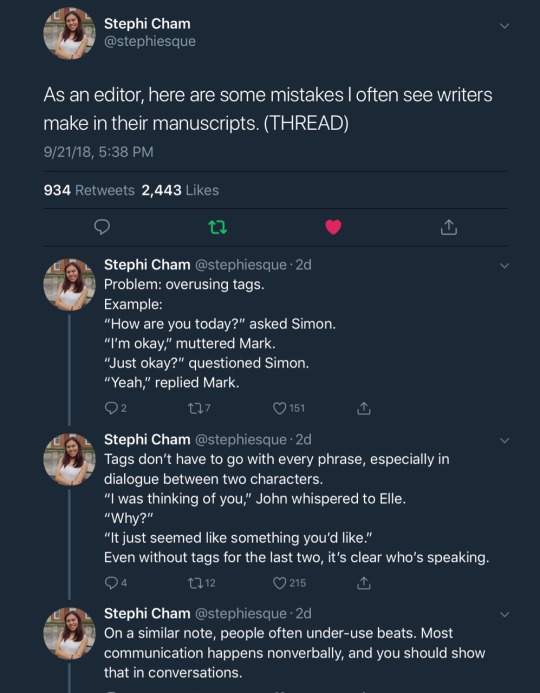
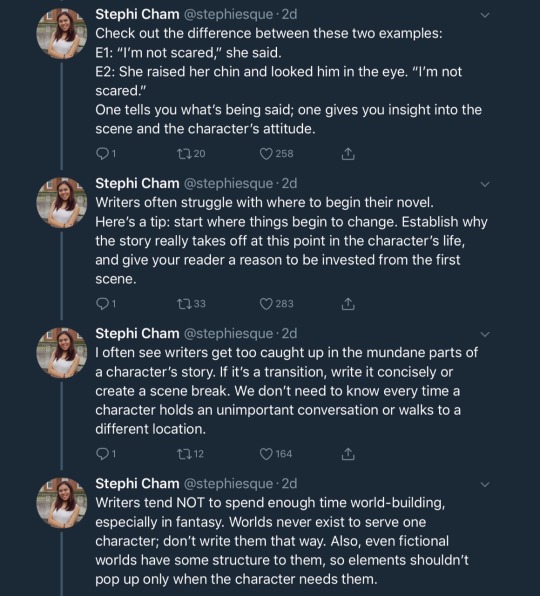
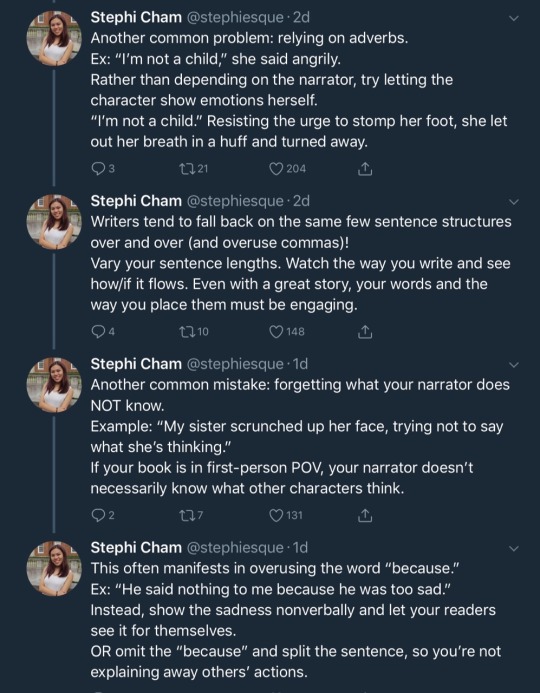
This. This is good fiction writing advice. I really appreciate how it was formatted as “this is a common problem, here is a solution to try in your own work” and not “oh god, don’t do that!” without any extra help. And I extra appreciated the “don’t rely on adverbs” bit, because they do have their place but they aren’t the only way actions can be emphasized.
I wanted to type up a little rundown of quick n dirty writing tips based on things I see a lot in fic/ amateur original manuscripts, and, uh, it turned out that they all revolved around POV. Nailing point of view in fiction writing is both crucial and one of the least intuitive building blocks of writing to learn: an understanding of POV has been the only useful thing i took from my college creative writing classes, and god knows how long I’d have stumbled along without it otherwise.
So! I am saving you, baby writer, the trouble of slogging through a miserable writing class with a professor who’s bitter as FUCK that genre fiction sells better than his “sad white man drinking” lit fic novels. Here are some assorted writing tips/ common mistakes and how to fix them, as relating to POV:
(this turned into a WALL OF TEXT so i will be using gifs to break it up)
>“I watched the ship tilt” “he saw the sky darken” “she noticed flowers growing on the rusted gate.” no. If the character who felt/saw/noticed etc is your POV character, whether in first or third, then this is called filtering and it takes the reader out of the story by subtly reminding them of the separation between the POV character and themselves. in most styles of writing, this is bad, not to mention it unnecessarily complicates your prose. try again: “the ship tilted.” “the sky darkened.” “flowers grew on the rusted gate.” Readers will instinctively understand that the POV character is witnessing the story happen, they don’t need to be told it.
I’m not telling you to never refer to your character “watching” something, of course: “I watched the birds dart around for hours,” isn’t filtering because watching is a notable activity, here, rather than an unnecessary obfuscation of the “real” thing happening. But understand how phrasing can jar readers momentarily apart from the character viewpoint, and use it with intention.
> Close Third Person POV still requires you to be mindful of your POV character. this is a rookie mistake i see allllllll the time. “Josh cried stupid tears at the beautiful display by the dancers,” is a sentence in Josh’s POV. “Stupid” tells us how he feels about the tears, “beautiful” tells us how he feels about the display. ok. all good so far. BUT.
“Josh cried stupid tears at the beautiful display by the dancers. It was everything he’d wanted from this production, from the lighting to the costumes to the exquisite choreography. Martha had to suppress a fond smile at his reaction; he was always so sweetly emotional after the curtain fell.”
Do you see what’s wrong with this paragraph? The first two sentences are Josh’s POV, and then the third one suddenly becomes Martha’s. A lot of amateur writers don’t even realize they’re doing this, which in its most egregious form is called “head-hopping,” but it’s disorienting and distracting for the reader, and makes it harder to connect with a single character. In multi-person close 3rd POV story, the POV should remain the same for an entire chapter (or at least, for an entire scene/ segment,) and change only between them. If you’re new to POV wrangling, watch your adjectives/ interiority (we’ll get to that in a second) and think “which character am I using as a lens right now, and am I being consistent" every once in a while until you get the hang of it.
> Related: let’s talk about interiority. Interiority is a more sophisticated way of thinking of a character’s “internal narration,” IE bits of prose whose job is not to advance the plot, set tone, or describe anything, (although it CAN do any of those things as well, and good prose will multitask) but to give us a specific sense of the character’s internal life, including backstory, likes, dislikes, fears, wants, and personality. In the above example paragraph, the middle sentence “It was everything he’d wanted from this production, from the lighting to the costumes to the exquisite choreography” Is interiority for Josh. It tells us that not only did he love the show, he’s very familiar with this art form and thus had expectations going in; likewise, listing the technical components is a way of emphasizing his enthusiasm while pointing out that it’s informed, implying that Josh himself is intellectually breaking down the performance even in appreciation.
“That’s a lot for a throwaway sentence you made up for an example.” Well, yeah, a little interiority goes a long way. Interiority is what creates the closeness we have to POV characters, the reason we understand them better than the non-POV characters they interact with. It’s particularly key in the first couple chapters of an original work, when we need to be sold on the character and understand the context they operate in.
If readers are having trouble connecting to or understanding the motivations of your character, you might need more interiority; if your story’s plot is agonizingly slow-moving (and you don’t want it to be) or your character is coming off as melodramatic, you might need less. It’s not something you should necessarily worry about; your amount of interiority in a WIP is probably fine, but being able to recognize it for what it is will help you be more mindful when you edit.
(Fanfic as a medium revels in interiority: that’s how you get 10k fics where nothing happens but two characters lying in bed talking and having Feelings. Or coffeeshop AUs that have literally no plot to speak of but are 100k+ long.)
>try not to describe the facial expression of a POV character, even in third person. rather like filtering, it turns us into a spectator of the character when they’re supposed to be our vessel, and since it’s *their* POV, there should be other ways available to communicate their emotion/ reactions. There are ways of circumventing this, (the example sentence where “Martha had to suppress a fond smile” is an example) where their expression is tied up in a physical action, or something done very deliberately by the character and therefore becomes something they would note to themselves, but generally, get rid of “[pov character’s] eye’s widened” and “[pov character] smiled.”
so that’s what i got! go forth and write with beautifully deliberate use of POV.



 Useless