In case anyone actually wants to know the answer: it’s the plot of Cars. The difference is literally the plot of Cars.
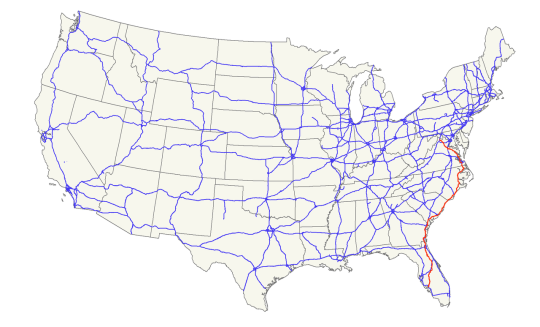
Highways are usually two-to-four (at the widest) lane roads that meander the US landscape. Think Route 66, dinosaur statues, mom-and-pop diners, southern gothic. There are state-level and national-level highways. Some run for a 100 miles, some, like US HWY-17, run most of the East Coast:
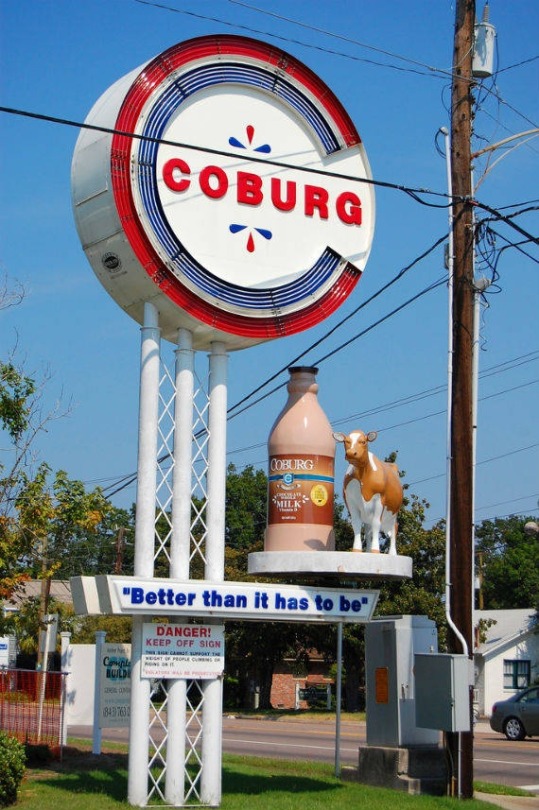
That red line is US HWY 17. If you follow it, you will go through tiny towns. You may hit stoplights. I kid you not, you will see spinning cows on poles. Businesses exist along highways that you are encouraged to pull over and visit. They were designed to let you see America.
Yeah.
Now, interstates were made in the 50s and were made to get people from Point A to Point B. These suckers range from four lanes to eight lanes around big cities. They cut through everything. If you want to get to a business, you have to take an exit ramp and detour. They are great for getting places fast. You can still have weird experiences on them, but usually at night, when your eyes start playing tricks on you. Or there are deer.
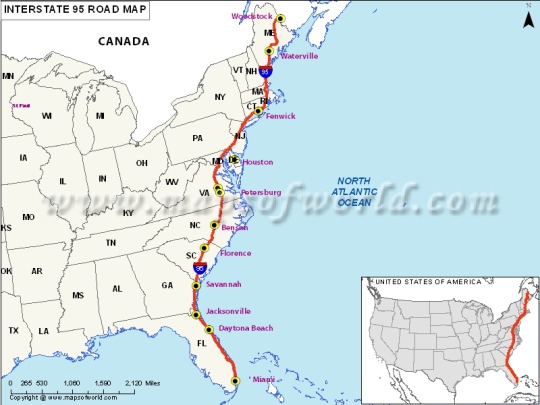
I-95 is a massive corridor that runs from the Florida Keys to the Canadian Border. You can see the difference just looking at the maps.
As far as writing goes:
If you want quirky character development inside the car, you’re looking for an interstate. The majority of Americans take interstates to go on road trips.
If you want mysterious and/or supernatural hijinks, you’re looking for a highway. They are weird, weird places, and they’re surprisingly easy to wind up on if you leave the interstate.
(Even in America, no one’s really sure what a freeway is. Just ignore it.)
Freeways exist in big cities where cars are more prominent than public transport, such as LA or Atlanta. You’ve year of liminal spaces? Freeways during rush hour are a physical manifestation of hell.
Awesome! Now what the hell is a turnpike?
If you find out, let me know. Maybe ask someone from New Jersey.
A turnpike is a highway with a toll. Turnpikes are special highways where you drive really fast and it’s usually linking big cities with each other and you keep going until you hit a toll booth.
They’re called “turnpikes” because in the olden days, there were pikes or barriers up and you had to pay the toll for them to be raised or turned to let you in.
For everyone who didn’t want to know, expressways are a form of highway that connect both suburban areas and major interstates to a city They often have both an alphanumerical name and a colloquial name In Philly we have the Schuylkill Expressway (I-76)
Would like to add that highways and mainly interstates were made specifically so THE MILITARY could get from Point A to Point B. This combined with a post-WWII boost in the economy and car industry gave Americans the ability to tour the country on their own for the first time ever. A whole chunk of American culture was created just by expanding the road system.
Think about road systems and other systems of travel when worldbuilding!
Asexual stories need to be told, so when BBC3 got in touch and told me that they wanted to cover the UK Asexuality Conference 2018 as part of a documentary on asexuality, I was excited to say the least. I would be speaking on two panels at the conference, providing some representation for Black aromantic asexual women. After coming out publicly as asexual last year, I have tried to use the platform I gained through fashion modelling to raise awareness for asexuality, so this opportunity was a perfect fit.
BBC3 were there from start to finish, filming the diverse display of asexual people I’ve ever seen. There were people from all walks of life – there were married asexuals, asexuals with children, transgender asexuals, Muslim asexuals, asexual people with disabilities, polyamorous asexuals, homoromantic asexuals, aromantic asexuals, teenage asexuals, and older asexuals. You name it, they were welcome and included.
We were filmed as we told our stories, such a powerful array of stories – some rocky, some smooth, but all equally empowering. BBC3 took a group of us aside for an in-depth group interview. The group was predominantly young and white, but it represented different types of asexuality and asexual experiences. But I soon realised that BBC weren’t interested in diverse experiences… They wanted the ‘lonely asexual’ trope.
When we sounded too positive, they were quick to put us in our place. They turned away from those of us who were happily aromantic, or happily in relationships, and drilled the singles for details about how it felt to be an unloved asexual who couldn’t find a partner. It seemed to displease them that some of us had even – god forbid – had sex and not hated every second of it. Quickly, they turned away from a guy who fit that category, rotated the camera to me, and asked, “If you had to have sex, how would that feel?”
“I wouldn’t have sex,” I answered.
“But if you had to, how would it feel?”
How would it feel if I was forced to have sex? Would a hypothetical rape make an aromantic asexual more interesting?
From then on, I sensed that BBC3 had an angle that they were sticking to, but I couldn’t have anticipated the patronising, whitewashed, exclusionary mess that they aired. They intelligently called the documentary, ‘I Don’t Want Sex,’ but what we actually got was, ‘The Undateables: Asexual Edition,’ and I was horrified.
I cringed as the cameras zoomed in on the presence of stuffed toys and action figures in one of the participant’s bedrooms, as if attempting to make her seem child-like. However, that was nothing in comparison to how I felt as an asexual guy was guided into a sex shop to test his levels of discomfort (which was obvious), or as they quizzed a girl on masturbation and vibrators in a room conveniently decorated with sexual images. I rolled my eyes as one of the participants eased an asexual guy through the art of texting a potential romantic interest, like teaching a child to read, and how an asexual girl not speaking to guys in a bar was treated as a cause for concern.
Asexuality is not synonymous with innocence and a lack of social skills, but it seemed like BBC3 didn’t want the public to know that. They also missed the detail that asking asexual people about what they do with their genitals is as inappropriate and invasive as asking as transgender woman whether she still has a penis. It’s an obvious, needless attempt to try and gauge how seriously someone should take another’s asexuality.
I was running out of hope by the time the conference was included in the last five minutes of the show, but I was curious to see what BBC3 had deemed important enough to show. Out of the hours and hours of footage they had of me, they decided to show me wiping my eyes, as if crying at the brief and uninspiring conversation about asexual clothing choices that they decided to air. Only, they knew that I had eyeliner in my eye. We had laughed about it on the day, they had supposedly paused the filming while I had been given a tissue to solve the problem. If I needed any more reason to suspect that the portrayal of asexual happiness was too much to ask for, that was it.
The closing statements of the documentary added insult to injury. “Cute asexuals do exist.” That’s the message that was taken from the conference? When we sat together for over an hour and opened up to BBC3’s cameras like it was some kind of group therapy meeting, I didn’t realise that we were being observed to see which was us were ‘cute’ enough to date. Well, the boys were, at least. It was time to add the old ‘asexual people aren’t good looking’ stereotype to the growing list featured in this documentary.
I am not just upset because BBC3 took an empowering, celebratory experience like the UK Asexuality Conference and tried to turn it into dating show. What bothers me the most about this documentary is the narrow, stereotypical portrayal of asexual people and asexuality – and just in time for Asexual Awareness Week. I know that BBC3 had the opportunity to do better, but they decided not to, even though this documentary could be the first and only time that people see real asexual people on a mainstream platform.
Asexual people aren’t just shy, white, young people who are sad because they can’t get dates. Despite BBC3’s desperate attempts to exclude us, aromantic asexual people exist, asexual people in happy relationships exist, asexual families exist, asexual minorities exist. Asexuality isn’t a new thing that only young people are doing. And asexual people are perfectly capable of living fulfilling, happy, complete lives, whether they date and have sex or not.
No porn on tumblr we describe our nudes in detail instead
today I was wearing a black corset with matching lace around it and a black leather miniskirt, pink fishnets and black combat boots. I was wearing black lipstick, white foundation, black eyeliner and red eye shadow. A lot of preps stared at me. I put up my middle finger at them.
Last chance to share some stuff on here sorta freely so I’m posting this hot off the press. PRETTY SURE IT’LL GET FLAGGED BUT HERE’S HOPING IT WON’T FOR NOW LOL



 Useless